How the CBR practical driving exam works
The standard category B practical exam takes 55 minutes in total, with roughly 35 minutes of driving. Before the drive, the examiner checks the formalities, explains the exam and normally includes an eyesight check and a few basic questions about the car. After the drive, you receive the result and the main feedback. See CBR exam stages.
During the route you drive partly on the examiner’s directions and partly independently with navigation. Special manoeuvres can be part of the assessment; an applicable exemption obtained through a tussentijdse toets may remove that part from the practical exam.
Useful mindset: do not try to predict the route or produce a “perfect drive.” The examiner is building a picture of whether you can handle normal traffic safely and independently when the situation changes.
What does the CBR examiner actually look for?
CBR describes the examination through seven driving components, including moving off, junctions, merging and exiting, overtaking or changing lanes, special road sections and special manoeuvres. Across those components, the Rijprocedure B describes expected driving behaviour: vehicle control, observation, priority, road position, speed, signals and consideration for other road users.
That is different from a fixed checklist of mirror movements or a numerical allowance of mistakes. What matters is whether your actions fit the traffic situation, whether they are timely and whether you can participate safely and independently. An observation that was correct several seconds ago may no longer be sufficient when you actually change lanes.
Observation and kijkgedrag: looking is not the same as seeing
Kijkgedrag is one of the words international learners meet very quickly. Good observation is not about making theatrical head movements for the examiner. It is about keeping an up-to-date picture of the traffic around the car and using it before you act.
That means looking early enough to make a calm decision. A mirror check at the exact moment you start steering is often too late. The same is true of a cyclist check during a right turn, or checking the motorway only when the acceleration lane is nearly finished.
Speed, space and traffic flow
Driving too fast is an obvious problem. Driving too slowly can also create problems when it no longer fits the road or traffic flow. The exam is not asking you to choose “fast” or “careful.” It is asking you to choose a speed that gives you control, visibility and time to respond while still moving with the situation.
The same principle applies to following distance, approaching junctions, passing parked cars and joining faster traffic. Space is what gives you time to think. If you use all of it too early, the next decision becomes rushed.
Priority, decisions and timing
Many stressful exam moments are not really steering problems. They are decision problems. The car approaches an equal-priority junction. A bus signals out. The roadworks are on your side. A tram appears from the left. You need to understand what rule applies, what can conflict with your move and whether your original plan is still valid.
The best decisions usually start earlier than learners expect: reduce speed while you still have room, identify the conflict, then commit when the situation is clear.
Key road situations on the Dutch practical driving exam
Motorway merging
A motorway merge is not a jump into a gap you selected ten seconds ago. The gap moves. Your speed changes. The vehicles beside you change position. Start reading the flow early, accelerate appropriately and keep updating the space you intend to use.
Read: Motorway merging during the CBR practical exam →
Lane changes
A mirror check gives you information for that moment, not permanent ownership of the lane. Signal early enough to communicate, make the relevant blind-area check and move only if the space is still there.
Read: Lane changes and the current gap →
Roundabouts
Roundabouts combine lane position, priority, observation, signalling and cyclists. If you miss the intended exit, the safe answer is not a last-second rescue. Continue the route safely and recover later.
Read: Missed a roundabout exit during the exam →
Cyclists and pedestrians
The Netherlands adds a lot of fast-changing information on the edges of the road: parallel cycle tracks, e-bikes, mopeds and pedestrians partly hidden by parked vehicles. Observation has to stay current until the conflict is actually gone.
Special manoeuvres: control beats perfection
Parking and reversing become difficult when the learner tries to rescue the manoeuvre instead of controlling it. The examiner is not looking for a cinematic one-move parking job. They need to see observation, low-speed control and safe completion.
If the angle is wrong, a calm correction is normally a better response than forcing the car into the space. Reference points can help you learn, but they change with the vehicle, seat position and mirrors.
Independent navigation: the route is not the exam
Current category B test terms include a period of independent navigation. The important part is not proving that you can obey every navigation instruction at any cost. If the instruction arrives too late, you are in the wrong lane, or the safe opportunity is gone, continue safely. See CBR independent-driving guidance.
A missed turn can be corrected by the route. A dangerous last-second lane change cannot be turned into a good decision just because it reached the destination.
Read: Independent navigation on the CBR exam →
Can you take the Dutch practical driving exam in English?
There is no separate English-language category B practical exam that you can select when booking. You can ask whether the examiner can use English, but you cannot rely on that as a guaranteed service.
If you need guaranteed language support, arrange an interpreter through your driving school before the exam. CBR guidance also treats the navigation system separately: the interpreter does not translate the navigation instructions, so the correct language needs to be set before the drive starts. See CBR interpreter requirements.
Practical answer: you do not need fluent Dutch to drive well. You do need a language plan before exam day. Learn the short driving commands you are likely to hear and make sure navigation is configured before the car moves.
Read the full English-language exam guide →
Faalangstexamen: more time, same driving standard
If exam anxiety is the problem, CBR offers a faalangstexamen. The appointment is longer than the standard exam, the examiner is trained to work with test anxiety and you can request a time-out during the drive. The actual driving standard is not easier. See CBR faalangstexamen details.
This distinction matters. If you drive at exam level during normal lessons but the exam situation makes your performance collapse, the different format can help. If the same driving problems happen during an ordinary lesson, more time around the exam will not replace the missing skill.
Read: How the CBR faalangstexamen works →
CBR practical exam day: what to arrange and bring
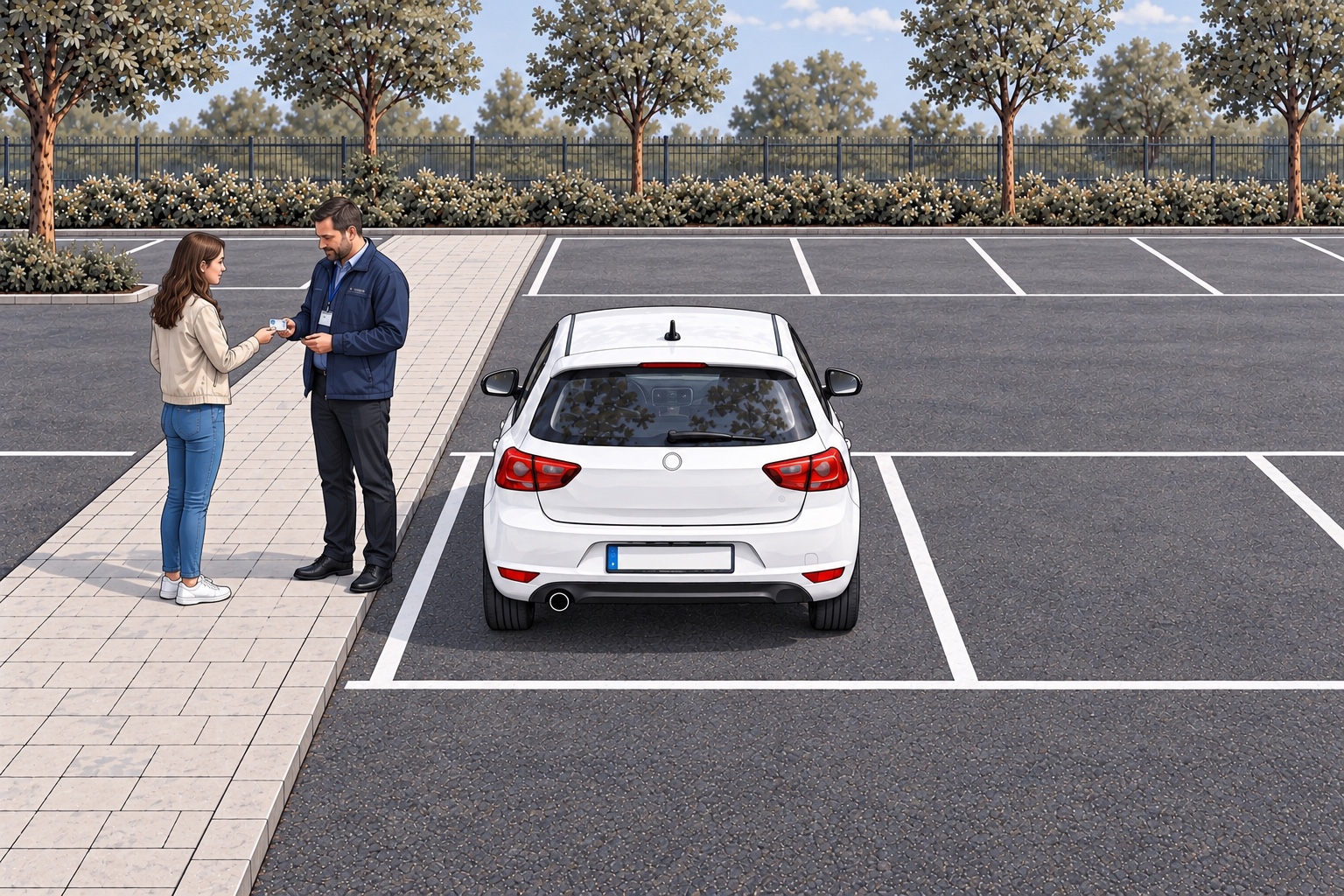
Your driving school books the category B practical exam. Before that, the health-declaration and school-authorisation steps need to be in order. Do not wait until the last possible moment to sort the administrative side.
For exam day, the current DTD fact-check based on CBR guidance includes:
- Bring a valid identity document.
- Complete the Zelfreflectie form. The examiner checks that it has been filled in and discusses it after the drive.
- Check beforehand that your theory result is valid on the examination date and that your driving school has completed the booking arrangements.
- Confirm any language or anxiety-exam arrangements with your school well before the appointment.
Before the drive, expect an eyesight check and basic vehicle questions. After the drive, you hear the result. If you do not pass, use the result categories as practice targets instead of trying to reconstruct one dramatic “fatal mistake.”
Read the full exam-day checklist →
Common preparation mistakes
- Looking only when a manoeuvre starts. Good observation creates the decision before the steering begins.
- Driving too cautiously everywhere. Safety includes fitting the speed and timing to the traffic situation.
- Following a memorised routine after the situation has changed. A gap, cyclist or signal can move while you prepare.
- Trying to rescue navigation. A wrong turn is easier to recover from than a dangerous last-second action.
- Treating parking as a performance. Slow control and continued observation matter more than a perfect first angle.
- Replaying the last mistake. The road has already moved on. Reopen the traffic picture and drive the next ten seconds.
Four common questions that change how you prepare
Can a single mistake make you fail?
CBR does not advertise a fixed number of minor errors you are allowed to make. The examiner evaluates whether you can take part in traffic independently and safely. A minor correction made with sufficient observation is not the same as creating a dangerous conflict. After the exam, ask for the specific situation and behaviour behind an insufficient assessment, not an invented tally of points.
What happens if you fail?
CBR states that the earliest retake after an unsuccessful ordinary exam is two weeks, while an exam stopped for dangerous driving has a longer minimum interval of fifteen weeks. Four unsuccessful attempts within five years also trigger a special subsequent exam. These are eligibility rules, not promises of an available appointment; your driving school must also arrange a suitable booking. Check the current CBR conditions before planning a retake. See CBR retake rules.
Can your instructor be in the car?
Usually you can choose. A CBR employee may occasionally occupy the additional seat, which prevents the instructor riding along for the drive. An instructor observing the exam cannot coach you. Decide your preference before the day.
Can you practise the route?
Train the types of road decisions you struggle with, not memorised turns. A late navigation instruction, a cyclist coming along a two-way track, or a vehicle changing speed beside a motorway merge is not solved by learning one exam route.
Source: CBR — official practical exam sequence, evaluation and retakes.
Frequently asked questions about the CBR practical driving exam
How long is the CBR practical driving exam?
The standard category B appointment is 55 minutes in total, with roughly 35 minutes of driving.
What does the CBR examiner look for?
The examiner looks at the whole driving picture: safe and independent driving, observation, priority, speed and space, anticipation, vehicle control and how you respond to changing traffic.
How many mistakes can you make on the CBR driving exam?
There is no useful public mistake allowance to count. The nature, seriousness and repetition of a problem matter more than a simple number.
Can you take the Dutch practical driving exam in English?
There is no separate English-language category B practical exam to book. You can ask whether the examiner can use English, but this is not guaranteed. If you need guaranteed language support, arrange an interpreter through your driving school before the exam.
What happens if you miss a turn during the exam?
Do not rescue the route with a late or unsafe manoeuvre. Continue safely and let the route be corrected. The driving decision matters more than forcing the navigation instruction.
Can you correct a parking manoeuvre during the CBR exam?
Yes. A calm, observed correction is better than forcing a poor angle. Keep the car controlled, move slowly and continue checking the space around you.
Is the faalangstexamen easier than the normal exam?
No. The driving standard is the same. The faalangstexamen gives more appointment time, a specially trained examiner and the option to request a time-out during the drive.
Reviewed 21 October 2026. Procedure details in this page were cross-checked against CBR Rijprocedure B (July 2026), CBR Eind- en toetstermen praktijkexamen categorie B (Woo20260023), and current CBR guidance used in DTD's 2026 fact-checks on booking, interpreters and the faalangstexamen. Requirements can change; check CBR for the latest administrative details before booking.
Driving Test Decoder is independent study material and is not affiliated with, endorsed by, or approved by CBR.
Driving Test Decoder
Want structured preparation beyond the overview?
The 57-page Driving Test Decoder guide brings together a preparation plan, road-situation explanations, the four DTD systems and exam structure in one reference.
View the full DTD guide