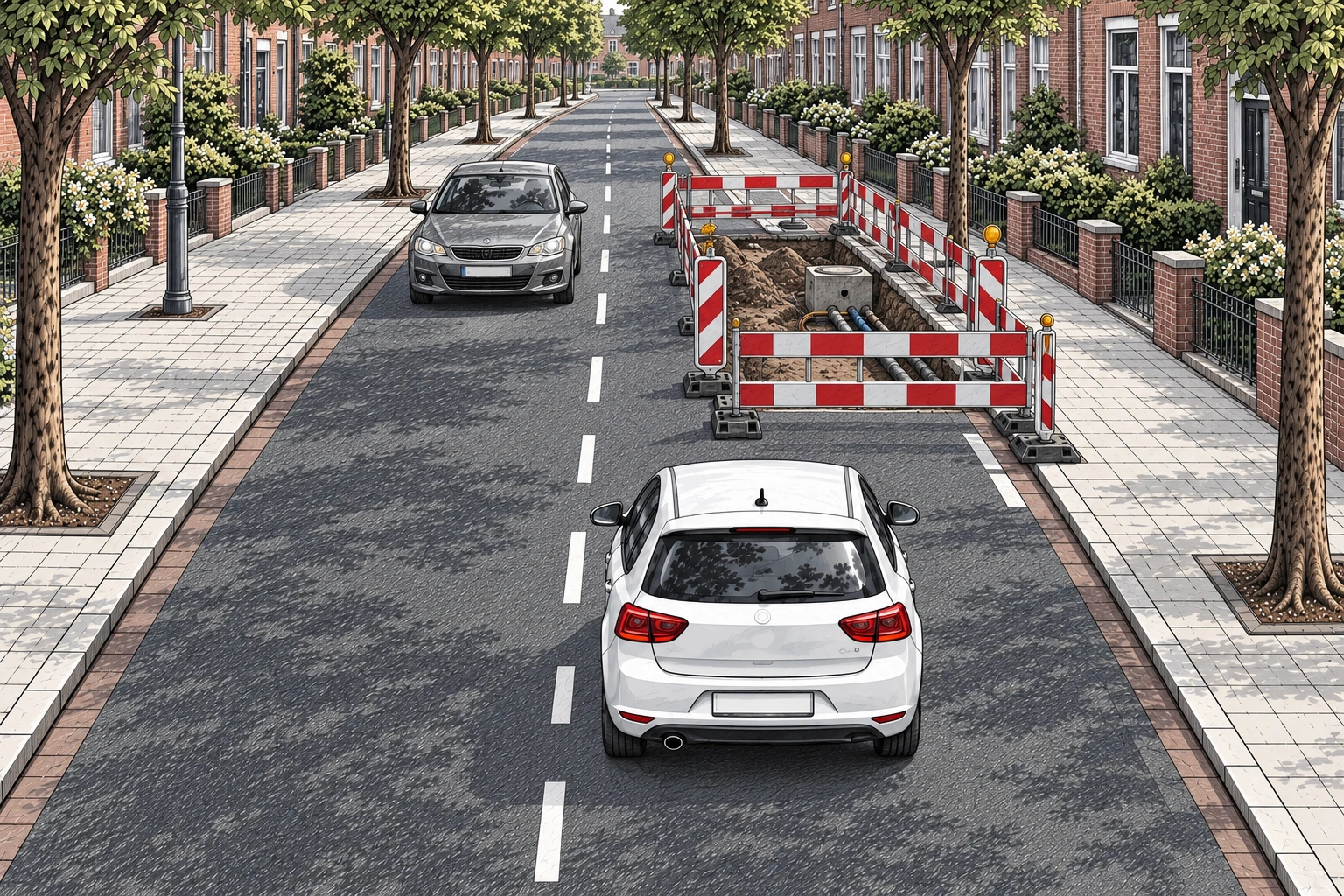
Roadworks are sitting in your lane. An oncoming car is heading for the same remaining strip of road. There are no temporary lights or priority signs in this scene.
Two cars do not become narrower because both drivers are in a hurry.
Who should wait when your side is obstructed?
A roadworks barrier does not establish the same priority everywhere. First read any temporary signs, traffic signals and instructions. If you must move into oncoming traffic to pass the obstruction, you cannot simply assume oncoming drivers will give you space. RVV article 54 also matters if your movement constitutes a special manoeuvre.
Choose a waiting point before entering the narrow section
Assess how far the worksite extends, where traffic could meet you and whether there is a space wide enough to let others pass. Wait in a position from which you can see ahead and allow approaching vehicles to clear. Do not enter a gap only to discover there is nowhere to wait without blocking the whole road.
What if the other driver flashes or waves?
A gesture may communicate willingness, but it does not replace checking the path. Look for cyclists emerging beside the barrier, vehicles behind the oncoming driver and any temporary lights. Move only if there is sufficient room to complete the pass without forcing other road users to brake sharply.
Two situations to train
Try a short obstruction with clear sight and a long obstruction hidden around a bend. In the first, you may be able to wait for a gap and pass in one smooth movement. In the second, slowing earlier and choosing a waiting place before the bend is the central skill. Practise observation and passing clearance rather than memorising which driver always goes first.
Sources: CBR Rijprocedure B, passing obstacles and meeting oncoming traffic; RVV 1990. Temporary site controls govern the actual scene.
Driving Test Decoder
Can you choose where to wait before the road narrows?
Use a free DTD scenario to practise choosing a safe waiting point, not just reacting once both cars are in the bottleneck.
Try a free road situation