
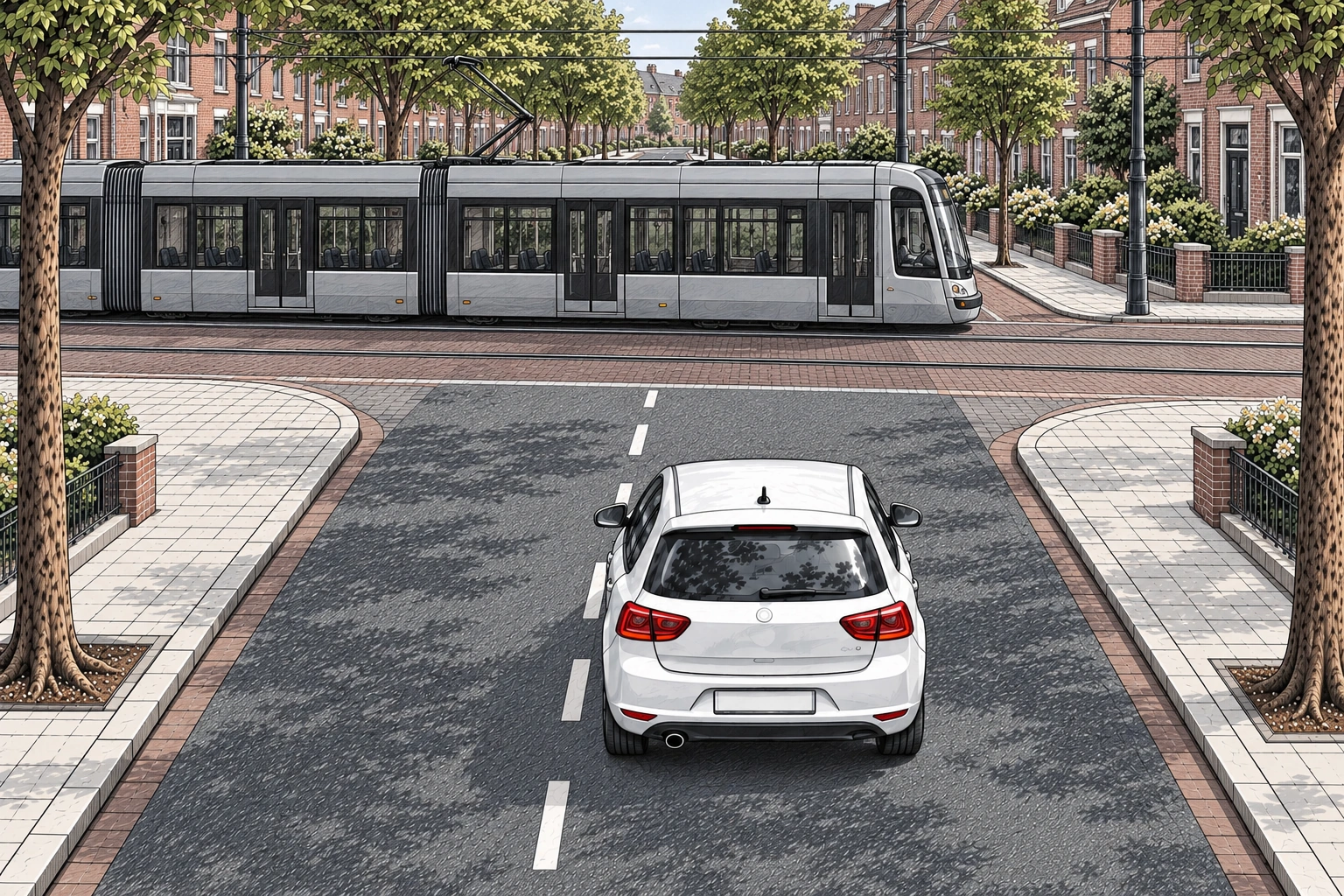
You reach an equal-priority junction on your CBR exam. No priority signs. No traffic lights. A tram is coming from the left.
The ordinary right-hand rule has an exception for trams. The situation requires a different decision.
Does a tram from the left have priority?
At an otherwise equal-priority junction, RVV 1990 Article 15(2)(b) makes an exception to the priority-from-the-right rule for trams. A tram can therefore have priority even when approaching from your left. That is not a rule to ignore signals and signs elsewhere.
Check which type of junction you are approaching
Read the traffic lights, tram signals, priority signs and road markings before applying the equal-junction rule. A controlled junction has its own directions; do not override a red light using the informal idea that trams always go first. If you are turning across the tram tracks, assess the track and the vehicles that can reach it during your turn.
What to do if the tram is approaching
Reduce speed early enough to observe its direction and whether it will cross your path. Choose a waiting position outside the tracks. Do not start crossing because the tram seems far away without considering its speed and the room needed to clear the rails. Once it passes, recheck other traffic before proceeding.
A simple exercise with three layouts
Compare an unsigned equal-priority junction, a signal-controlled junction and a road with separate tram tracks. Ask which rule applies in each, where you would stop and which space must be clear before moving. That teaches the distinction rather than one unsafe shortcut.
Assessment reference: CBR Rijprocedure B, junctions.
Driving Test Decoder
Test which priority rule applies at this junction
Use a free situation to practise reading signs, traffic lights and the tram exception instead of relying on “tram always wins”.
Try the free road situation