
Before the junction
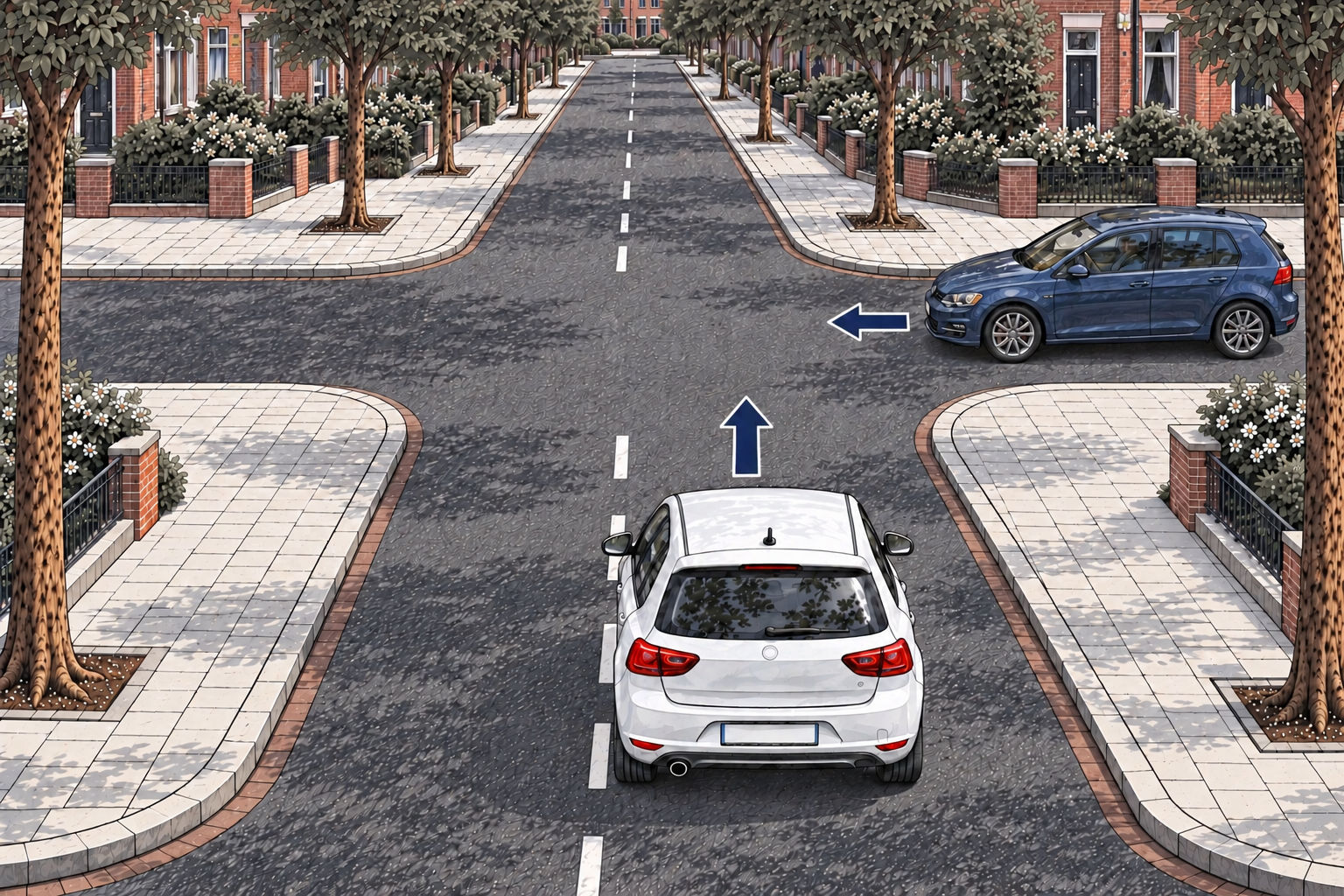
This example shows an equal-priority junction between paved roads. Read the signs and layout as you approach, and adjust your speed while you still have room to wait. Going straight does not, by itself, give you priority over a driver coming from the right.
The other car arrives
Let the car from the right go first. The examiner assesses observation, speed and giving priority where required. That includes whether you noticed the situation early enough to make a calm decision. A clear, controlled approach is more useful than arriving quickly and then making everyone guess what you're doing.
Your turn to move
After the car passes, scan the junction again and continue only when safe. Traffic elsewhere may have changed while you waited. Don't turn one successful check into permission to stop looking. Priority signs, an exit construction, trams or an unpaved side road can change the situation; this example is not a rule for every unsigned junction.
When a road from the right does not have ordinary priority
- Exit construction (uitritconstructie). A vehicle leaving one, often marked by a continuous pavement or cycle track across the entrance, is doing a special manoeuvre and must let other traffic go first.
- Unpaved road. A driver on an unpaved road gives way to drivers on a paved road. Different paving material alone is not this exception.
- Priority signs. Signs override the equal-priority rule.
- Trams. At an unregulated equal-priority junction the tram is the exception; see tram from the left.
Identify the actual construction rather than guessing from how wide the side road looks.
What if you have priority but the other driver does not slow down?
Anticipate that someone may fail to yield. Adjust speed or wait if continuing would create danger. Having priority is not permission to drive into an avoidable collision. The skill being assessed is reading the actual conflict early, including signs that the other person will not follow the rule.
Common mistakes
- Applying "from the right" to every side entrance.
- Speeding up because you believe you have priority.
- Forgetting cyclists and pedestrians at the entrance; see cyclists and right turns.
The legal priority rule
At an equal-priority junction, drivers let those approaching from the right go first under RVV 1990 Article 15. Its exceptions include trams and the relationship between an unpaved and paved road. The CBR Rijprocedure B applies the rule to observation and junction approach.
Driving Test Decoder
Which road user actually has priority?
Try a road-layout exercise and identify the rule before deciding whether to proceed.
Try a free priority scenario