
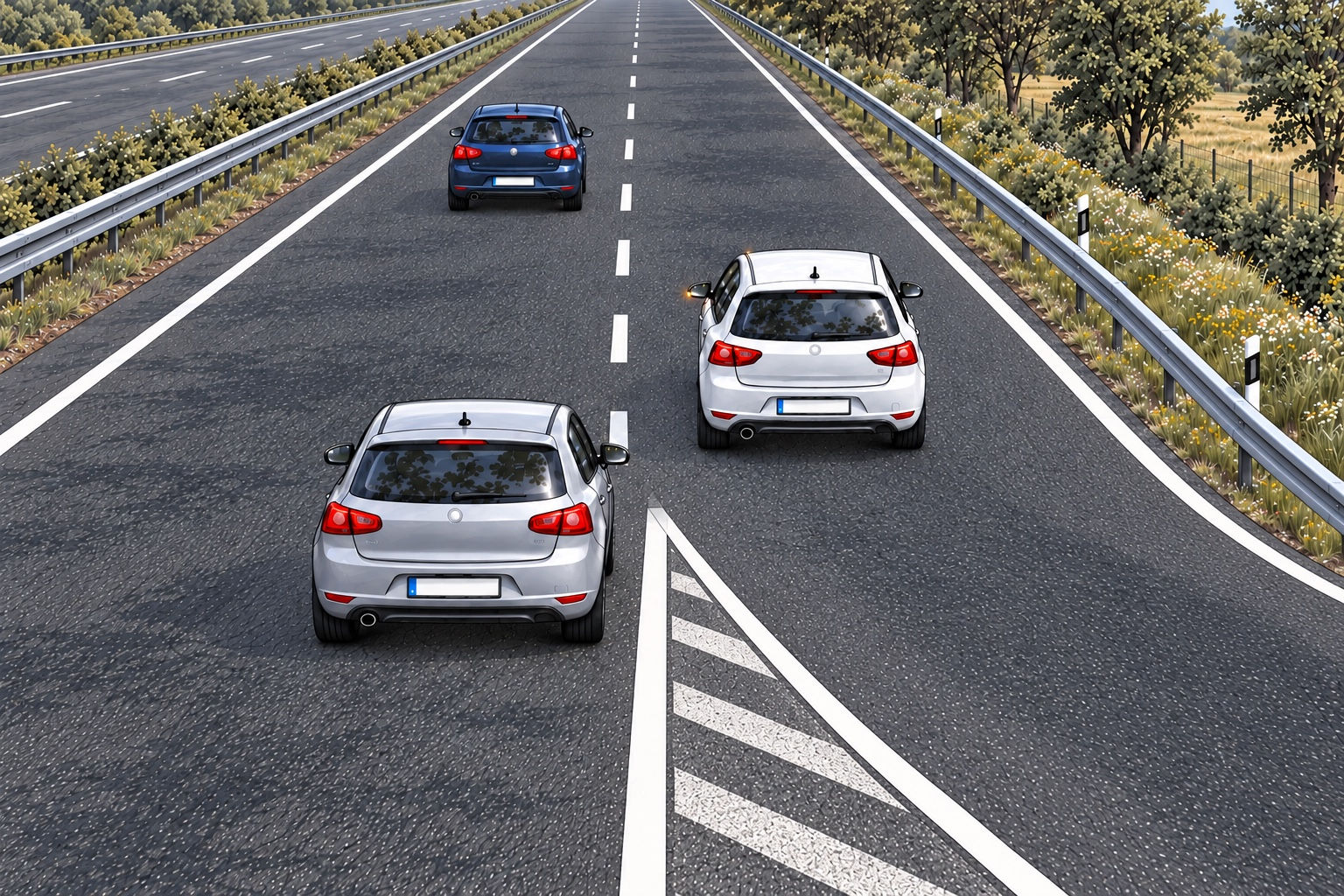
Build the traffic picture
Use the available slip road to adjust your speed towards the flow as conditions allow. Keep watching the road ahead while checking the through lane. Staring left won't keep the gap open, and it takes attention away from your own path.
Check the actual opportunity
The examiner assesses observation, speed, position and yielding to traffic already on the motorway. Check your mirrors and briefly check the left blind area before entering. Indicate your intention, but don't treat that as a request other drivers must fulfil. The space needs to be safe without forcing them to make room.
Merge and settle
When a checked gap is available, enter smoothly, settle your position and speed, then cancel the indicator. If the selected gap closes, reassess. If none becomes available, the length and end of the slip road change your options. That needs a separate scene, not a throwaway 'just keep going' instruction.
Who has priority when you merge?
Joining the main carriageway from an entry lane is a special manoeuvre under RVV 1990 Article 54: let other traffic go first. Your indicator communicates intention, not a claim over a gap. The CBR Rijprocedure B expects early observation, traffic-matched speed where possible and effective use of the entry lane.
What if no gap appears?
There is no universal "always stop" or "never stop". An entry lane may end in a taper, become a continuous lane or run beside an emergency shoulder. Do not force your way in, cross a prohibited line or use the hard shoulder as an extension of the lane. Keep control and use the lawful, safe options the real road gives you.
Section 3.4 of the July 2026 Rijprocedure also covers combined merging-and-exit lanes, where you must watch traffic already trying to leave the carriageway.
Practise it
Try different entry lanes with your instructor. After each, ask: when did I first see a gap, when did it change, was my speed right at the merge point? Related: lane changes and hesitation.
Do not confuse a true merge with a continuing lane
Some approach roads become a full running lane rather than ending in a merge. Check signs, road markings and the lane’s continuation before making an unnecessary lateral move. This distinction matters in the CBR Rijprocedure B, section 3.4, which also covers combined entry and exit lanes where two streams interact.
Driving Test Decoder
Practise choosing a live gap.
The DTD guide connects lane observations, speed adjustment and the timing of a safe motorway merge.
Complete guide · €27 + applicable VAT