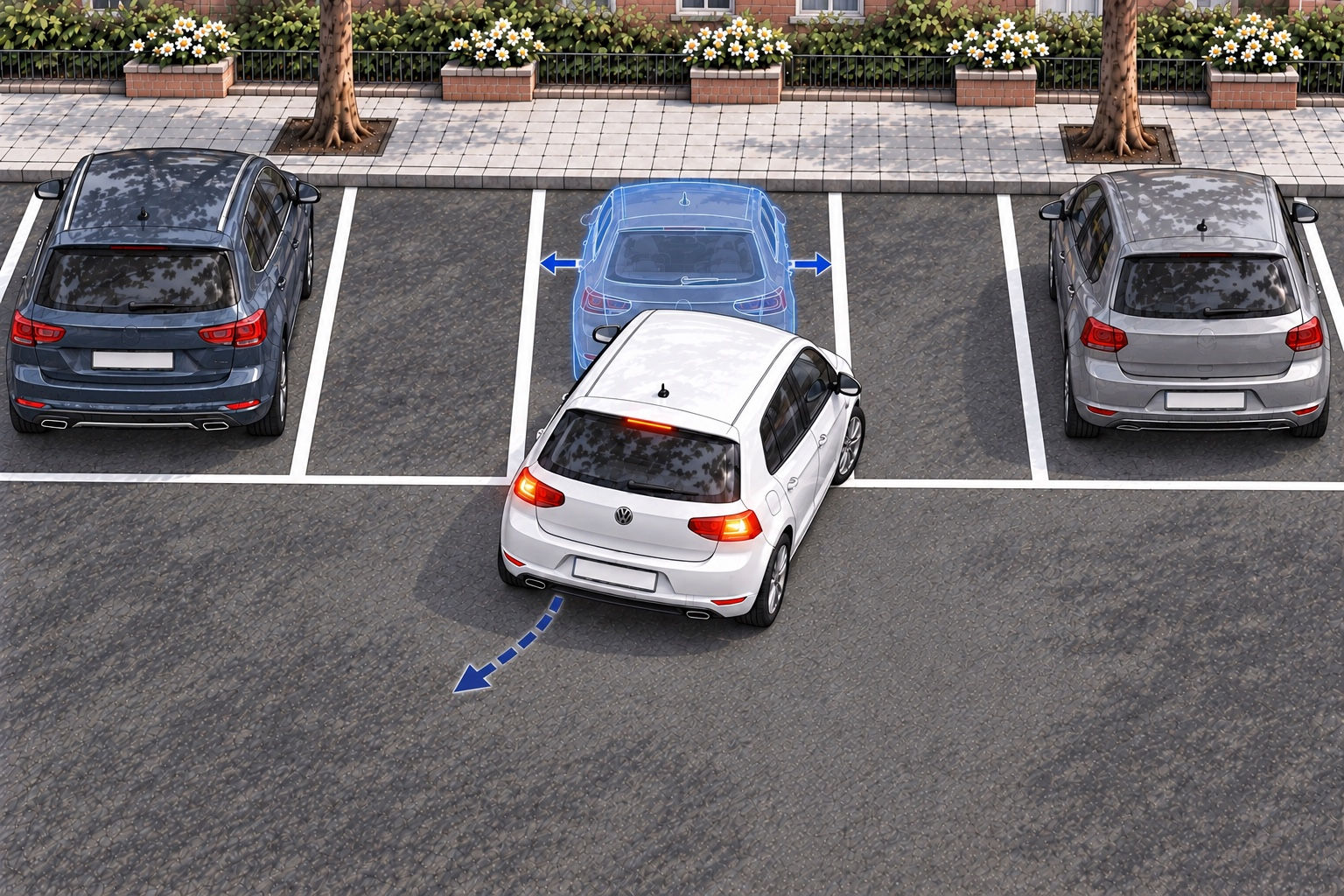
Meanwhile, the car is still halfway into the space.
The manoeuvre is your job
During a special manoeuvre, you are responsible for choosing a safe place, controlling the vehicle, observing the surroundings and letting other road users go first where required.
If the position is not working, continuing a bad line does not make it more correct.
A correction is still driving
Pause if needed. Observe around the car. Check the space you are about to use. Correct the position in a controlled way and keep watching while the vehicle moves.
Do not turn “I am fixing the angle” into permission to forget the cyclist, pedestrian or car that has appeared behind you.
How to correct safely: 5 steps
- Stop. Do not keep moving while you decide.
- Look all around. Mirrors, behind, ahead, and the pavement. Something may have appeared during the manoeuvre.
- Decide how big the problem is. A small forward correction can be enough. If the car is badly placed, pull out and restart.
- Move slowly and keep looking while the car moves.
- Check again every time you change direction. Going forward after reversing means a new area to observe.
When to pause or choose a new approach
- The position cannot be corrected safely with the space you have: stop and re-assess before choosing a new approach.
- A cyclist, pedestrian or vehicle appears: stop, let them pass and look again before moving.
- If traffic is waiting, do not rush or pull out into its path to finish faster. Find a safe way to complete or leave the manoeuvre.
Three corrections that are not the same mistake
You are too far from the kerb: stop and check the space before making another controlled adjustment. The vehicle is crooked inside a parking space: re-assess both neighbouring vehicles and the space behind before repositioning. A cyclist has entered the area behind you: stop the manoeuvre altogether, allow the cyclist to pass, then make a new observation before moving.
A correction does not suspend the rules. Reverse parking, turning round and pulling away are special manoeuvres: under RVV 1990 Article 54, drivers performing them must let other traffic go first. Check the relevant assessment in the CBR Rijprocedure B.
What can a candidate say during a correction?
You do not need to deliver a running explanation. If you need a moment to check or adjust, do so in control. If a direction is unclear, ask a short question when it is safe. Keep attention on other traffic rather than trying to persuade the examiner that the first attempt should not count.
Driving Test Decoder
Make a safer second attempt.
Use the complete guide’s manoeuvre system to link positioning, all-round observation and recovery instead of learning parking tricks.
Complete guide · €27 + applicable VAT