Leave room as you pass
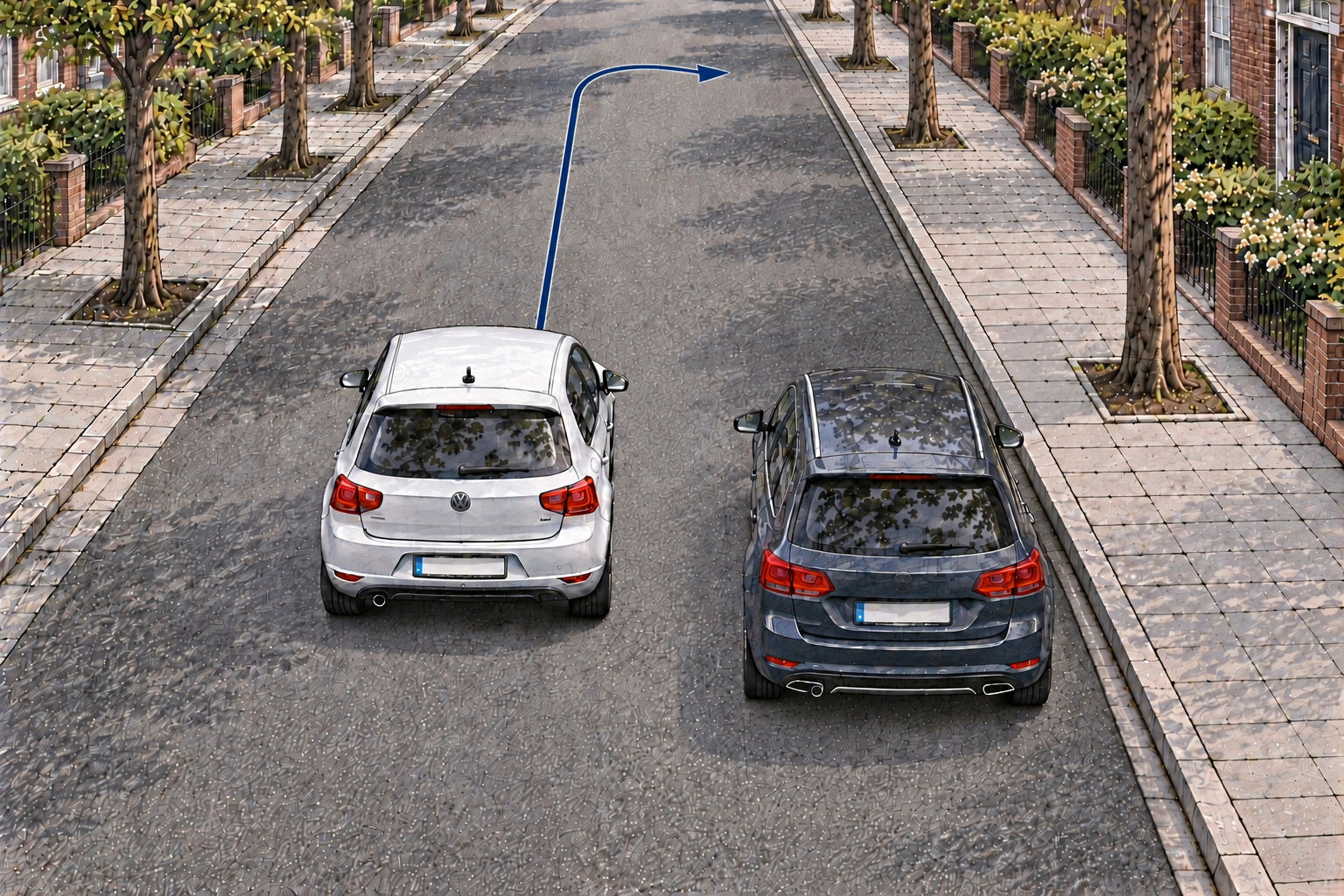
Keep enough clearance from the parked car. Don't steer back as soon as your front bumper has passed it. Your car still needs space to get fully clear before returning to its normal road position. The manoeuvre isn't finished just because the obstacle has disappeared from your forward view.
Check before returning
The examiner assesses the space you leave and how you return to the correct position. Briefly check over your right shoulder, then check the right mirror before moving back, keeping awareness of the road ahead. Even when you haven't noticed anyone beside you, check the space before you steer into it.
Return when safe
If the space is clear, move back smoothly and settle your position. If it isn't safe, don't steer into it: reassess the traffic situation. The useful habit is simple. Finish passing the obstacle, check the space you're about to use, then return. Not all three at once.
What about a door opening?
Keep a safety margin: an occupant can open a door or step out between cars before you can brake. Look for clues such as a person inside, brake lights, or movement near the kerb, but do not assume an empty-looking car is safe. The exact clearance depends on road width and other traffic.
If an oncoming car leaves too little room
Choose a waiting position before the obstruction. Do not squeeze closer to the parked cars to solve the width problem. The same idea applies at roadworks on your side.
Why returning too early is different from waiting too long
Move back right only when the rear of your vehicle is clear of the parked car and you have space to do so without cutting across another road user. That includes a cyclist moving into the space on your right or a vehicle following the same route. Look ahead and update your relevant mirrors and blind area immediately before the lateral move.
Staying left unnecessarily after the obstruction has ended can also affect other traffic. The aim is not to hug the obstacle or avoid moving back; it is to choose a safe, timely return. Where several parked cars form one continuous obstruction, assess whether repeatedly weaving in and out would create more conflict than passing the group with adequate clearance.
Does moving back right need an indicator?
Signalling is required for important lateral movements and the movements covered by RVV 1990 Article 55; decide based on your actual movement and traffic, rather than treating every tiny steering correction as an identical lane change. The signalled intention never removes your duty to make the move safely.
Check the whole obstacle, not the front bumper
In a lesson, ask your instructor to demonstrate where the rear of your car is when the obstacle disappears from the windscreen. The correct clearance varies with vehicle length, relative position and road width. Practise judging space with the actual car rather than treating a fixed count of seconds as a CBR rule.
Source: CBR Rijprocedure B, passing an obstacle; RVV 1990 Article 55 on signals for important lateral movements.
Driving Test Decoder
Know when the pass is actually finished.
The guide links road positioning, observation and space around obstacles to one practical decision.
Complete guide · €27 + applicable VAT