
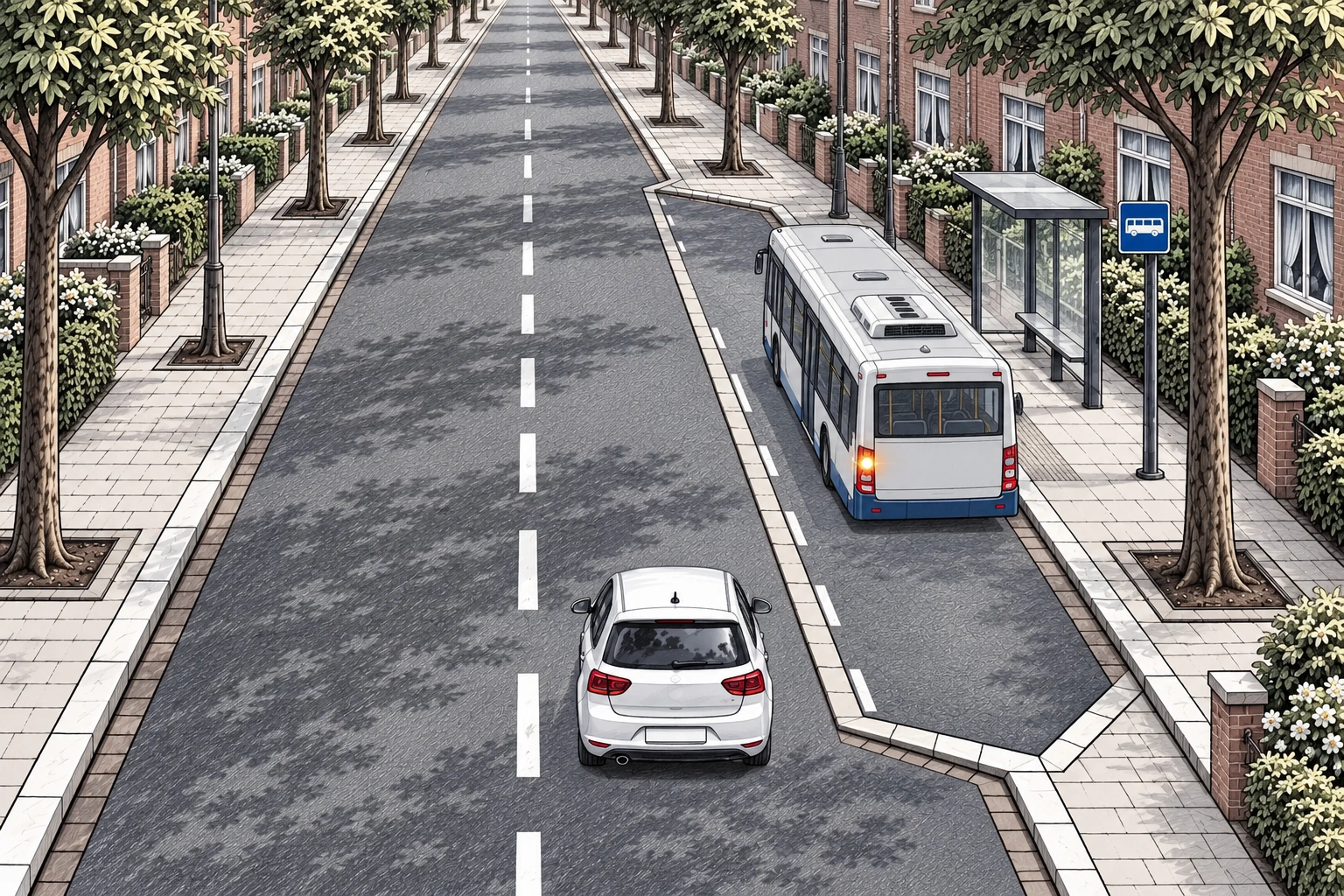
A bus is standing at a stop, so your brain has filed the next step under “pass it”. Then its indicator comes on. That changes the decision you were about to make.
When must you let a bus leave the stop?
RVV 1990 Article 56 requires drivers inside a built-up area to give a bus driver the opportunity to leave a bus stop when the driver signals that intention. It is a specific rule, not blanket priority for every bus displaying an indicator. Outside the built-up area, or if the bus is leaving somewhere other than a bus stop, do not apply Article 56 automatically. Read the actual road layout and other applicable rules.
What if the indicator appears as you approach?
Spot the stop early. Notice whether the bus is stationary, whether passengers are moving, and whether its driver has signalled to leave. Check behind before reducing speed, create room smoothly if you can, and leave enough lateral space for the bus to pull out. Do not accelerate to squeeze past once its intention is clear.
If you are already beside the bus when the indicator comes on, an emergency stop cannot rewind your position. Keep control and respond to the space that exists; do not swerve into oncoming traffic. The rule does not excuse an unsafe movement by either driver.
Who else might be beside the bus?
The bus can hide a cyclist, a pedestrian near the stop or traffic approaching in the opposite direction. A gap large enough for your car to pass may disappear as the bus starts to move. Keep watching the area you intend to use rather than staring at the indicator. Once the bus has left, recheck before following it.
Compare three lesson scenes: an indicating bus at a stop inside town; the same bus with no departure signal; and a bus leaving a stop beyond the built-up-area sign. State which rule applies and where you would position the car. In the first scene, a driver behind honking does not change Article 56.
The CBR Rijprocedure B describes anticipation, adjusted speed and observation. The exam task is to recognise when the bus-stop rule applies and respond to the current traffic, not to treat every bus as an identical obstacle.
Driving Test Decoder
Practise spotting the moment the rule changes
Use the free road-situation test to apply observation and right-of-way rules before memorising a response to a bus indicator.
Try the free road-situation test