The route is wrong. Your driving does not have to be.
Amsterdam can throw a lot at you in a short distance: cyclists, lane arrows, crossings, unfamiliar layouts and changes in speed limits. It is easy to become so focused on where the navigation wants you to go that you forget the more important question: is that movement still safe and legal from where I am now?
That is what you should practise before your CBR practical exam. Not the perfect sequence of streets. The ability to make a good decision when the planned route no longer fits the traffic.
CBR Amsterdam: the location is not the route
CBR lists its Amsterdam exam centre at Naritaweg 150, 1043 CA Amsterdam. Check your own appointment confirmation and meeting instructions before travelling. This article does not claim to know which streets the examiner will choose.
Lessons near the centre can be useful for learning to recognise the kinds of situations you find difficult. A memorised route cannot guarantee that a gap stays open or a lane change becomes possible.
One useful rule: a navigation instruction is information. It is not permission to cross a solid line, cut across lanes or make someone else brake for your late turn.
What should you practise in Amsterdam?
Look far enough ahead to understand the signs and lane arrows. If the correct lane is no longer safely available, stop trying to repair the route. Follow the lane you are in and let the navigation recalculate.
Amsterdam has many arrangements for cycles, but they are not all the same. Check the layout and actual priority first. Before turning across a cycle path, make sure the picture is still current.
Amsterdam has lowered the limit on many roads, including the Weesperstraat in 2026. Other roads can have a different limit. Read the signs and zone boundaries, then choose a speed that fits visibility and available space.
The instruction comes late; the traffic does not disappear. Prioritise observations, lane position and other road users. You are being assessed on the driving, not on whether you reach the suggested turn.
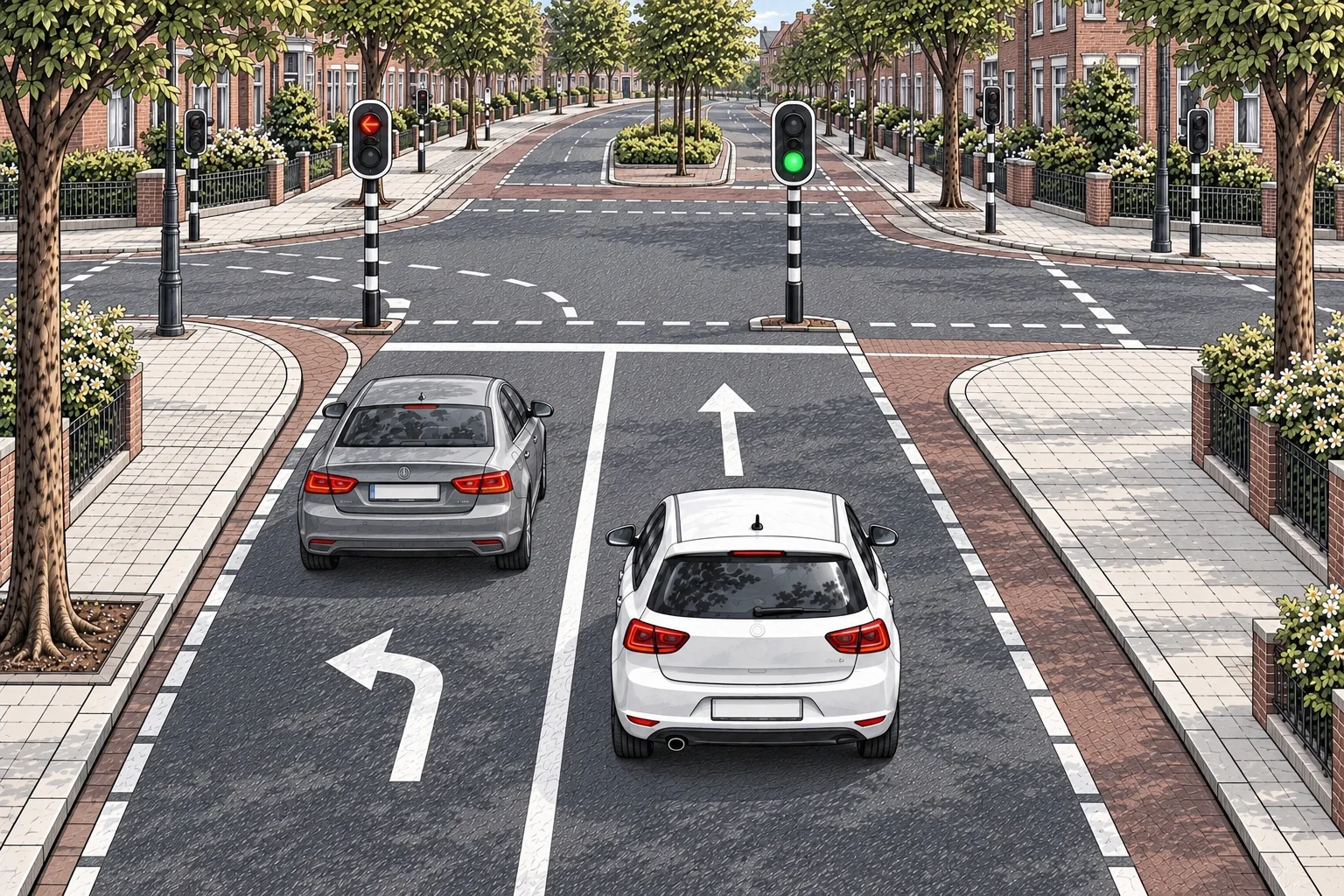
The left turn is there. Your lane is not.
You approach a multi-lane junction. The navigation announces a left turn. The left-turn lane is separated from yours, and another car is travelling alongside you.
You know where you wanted to go. You do not have the space or legal position to go there.
The navigation plan no longer matches your position. The turn you wanted is not safely available.
Your current lane arrows and markings, the vehicle beside you and the time and space required for any manoeuvre.
Continue with the lawful movement from your lane. Do not make a sudden lane change or cross markings to rescue the instruction. Take the next safe opportunity to change route.
That is not a failed navigation task. It is a driving decision. The road changed what was possible; you adjusted your plan.
Take these three exercises to your instructor
Use ordinary, legally supervised lessons. The goal is to practise the decision process, not to rehearse a specific street until it feels familiar.
Before a suitable multi-lane junction, read the signs and arrows yourself. Explain which movements are allowed from your lane. Do it early enough that there is no dramatic last-second correction.
Move between roads with different signed limits during a lesson. Identify the actual sign or zone boundary, then explain why the safest speed could still be below the maximum.
Ask the instructor to give a late direction in a safe practice setting. When changing lanes would be unsafe or illegal, continue on your course. Notice how little actually goes wrong when you stop chasing the route.
What should an Amsterdam candidate do with tram priority?
Trams are worth practising, but their priority is not one slogan. At an equal-priority junction, RVV 1990 Article 15 requires drivers to give way to a tram, including one approaching from the left. At a signal-controlled junction, check the signals for your movement; when turning across a tram going straight on the same road, check the turning rule too. See the tram priority example and train more than one layout.
What if cycling traffic crosses your turning path?
Before turning across a cycle track, identify its direction and any separate signs or give-way markings. In some layouts cyclists approach from both directions. Check the crossing just before entering it, particularly after you have already waited for the first cyclist. This is more useful than remembering a supposedly “typical Amsterdam exam route”.
What is CBR looking for here?
CBR looks at the way you handle traffic safely and independently. A legal, calm continuation after a missed turn can show better judgement than a rushed attempt to obey the navigator. Equally, a perfectly followed route says little if you failed to notice a cyclist beside you.
For DTD, that means bringing together observation, space and speed, decision and timing, and manoeuvre control. These are DTD learning systems based on driving behaviours, not names of official CBR grading categories.
For the individual situations, read our articles on late navigation instructions, lane changes and cyclists during right turns.
Would you still make the right decision if the route surprised you? Start with our free interactive test. The complete guide connects the decisions to the four DTD systems.
Questions about the Amsterdam driving exam
Should I memorise driving-test routes around CBR Amsterdam?
Knowing the area can reduce unfamiliarity, but you cannot rely on a fixed exam route. Practise reading the road and adapting when the situation changes.
What if I miss a turn during my CBR exam?
Do not turn a navigation mistake into an unsafe manoeuvre. Continue safely and legally from your lane, then follow a corrected route when appropriate.
Is the speed limit 30 km/h everywhere in Amsterdam?
No. Read the signs and zone information on the road you are using. The posted maximum and the safe speed for the situation may also be different.
Sources and scope
The scenarios are illustrative, not reports of actual CBR Amsterdam exam routes. The learning approach is based on CBR practical exam assessment overview (July 2026) and applicable Dutch traffic rules. Confirm all administrative details with CBR before the exam.
Editorial check: 21 October 2026. Driving Test Decoder is independent study material; it is not affiliated with, approved by or endorsed by CBR.