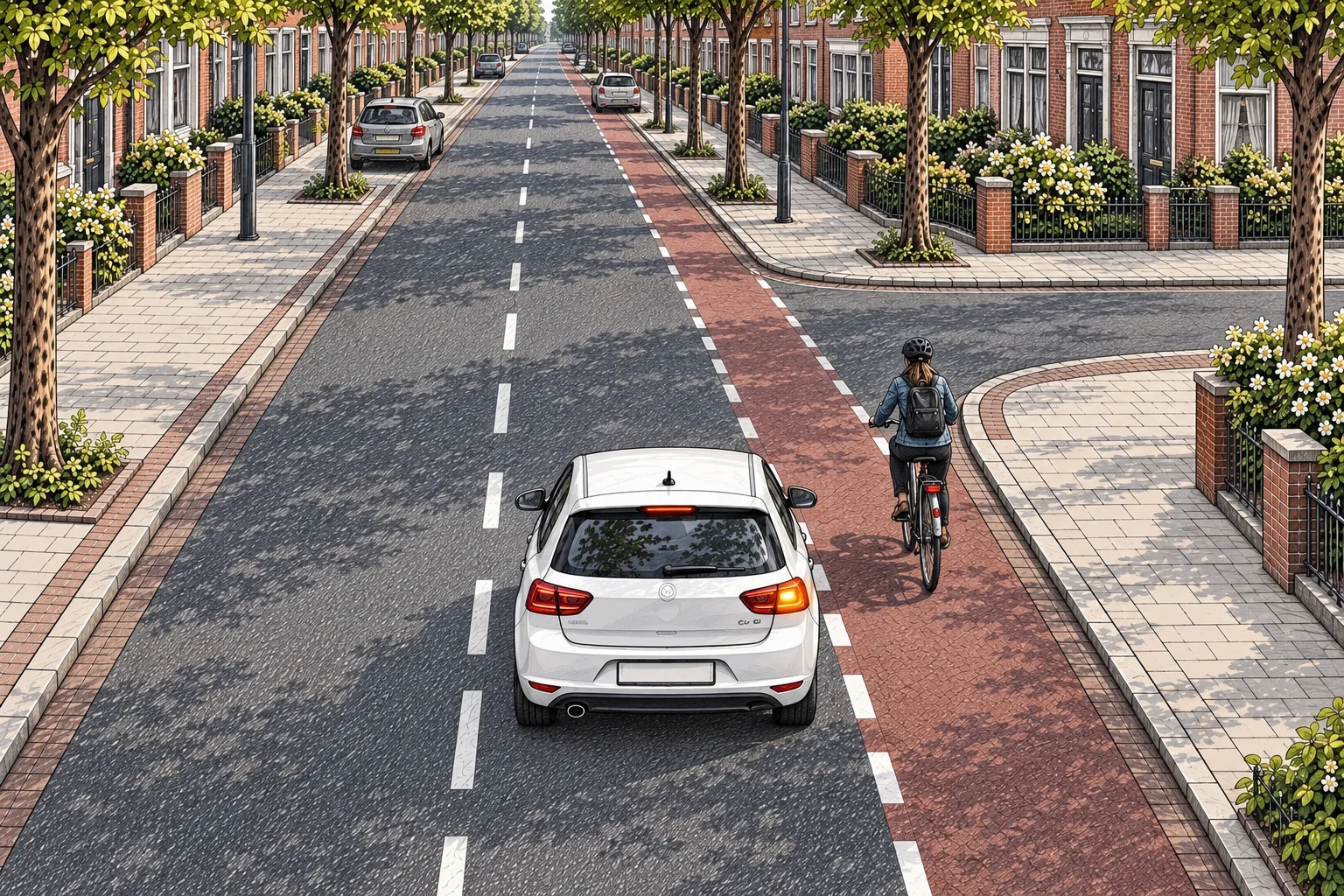
The same street. A different decision.
It is tempting to spend your last driving lessons looking for “the Utrecht exam route”. You find a map, repeat the turns and start recognising the road. That can help you feel more familiar with the area. It does not tell you what to do when the traffic changes.
A cyclist arrives later than last time. A car waits where you expected a clear junction. A vehicle behind you changes the space available for a manoeuvre. The road is familiar. The problem is new.
What matters on the CBR exam: not whether you remember the next turn, but whether you notice what has changed, understand who has priority and act while there is still time to do it safely.
CBR Utrecht: where are you taking the test?
CBR lists its Utrecht centre at Mississippidreef 151, 3565 CE Utrecht. Use the exact address and arrival instructions on your appointment confirmation and check with your instructor.
Practising in the area can be useful. Use the roads as different exercises, not as a script you hope the examiner will follow.
Four things worth practising around Utrecht
You reach a junction. Your road feels like the main road. Before you decide, find the signs, markings and actual junction arrangement. If priority is equal, apply the rule that belongs to that situation. Road width is not a substitute for looking.
You checked right. Then you slowed, signalled and waited for another car. Where is the cyclist now? Your first check was useful information then. It may no longer be enough when you start turning.
Do not treat the exit as the end of the manoeuvre. Read the markings and priority arrangement, check the relevant cycling and pedestrian movements, and make a fresh decision before crossing their path.
A lower limit is not permission to stop paying attention, and a clear road is not an instruction to drive at the maximum. Notice visibility, available space and traffic flow. Choose a speed that leaves you enough time to respond.
Your turn is ready. The cyclist has moved.
Imagine an ordinary urban junction. You intend to turn right. Earlier, you saw a cyclist approaching from behind on your right. You check, signal and reduce speed. A moment later you are ready to turn.
Except the cyclist did not stop moving just because you were preparing.
The picture you had a few seconds ago is no longer current. The cyclist may now be close to the place your car will cross.
Where the cyclist is now, whether your paths conflict, and who must yield under the actual road layout and rules.
Update the relevant observation before committing to the turn. If the crossing path is not clear or you must yield, wait. Move only when the situation allows a safe turn.
The useful skill is not “turn right at this Utrecht junction”. It is recognising when yesterday's — or three-seconds-ago — information has expired.
Which junction decisions are worth practising before a Utrecht test?
At a residential equal-priority junction, identify the real status of each approaching road before applying priority from the right. At a right turn across cycle traffic, watch for cyclists both alongside and approaching a separate two-way track. At a roundabout, read the entry signs and markings rather than treating all Dutch roundabouts as identical. These are transferable driving skills; none implies that CBR uses a fixed Utrecht route.
Three exercises for your next driving lesson
Use these with your qualified instructor, in suitable traffic conditions. You do not need a secret route.
Practise right turns with two different arrangements for cycle traffic. After each turn, identify the observation that actually determined your decision. Do not just count head movements.
Approach different junctions. Ask yourself which sign, marking or rule applies, and whether you have seen enough to decide. If you cannot answer yet, that is your cue to adjust early — not to guess.
Ask your instructor to change a direction at an appropriate moment. If a safe, legal change is no longer possible, continue correctly. Missing a requested turn is better than inventing a dangerous one.
What does the examiner actually see?
The examiner cannot read your thoughts. They can see whether you noticed relevant traffic in time, adapted your speed, respected priority and carried out a safe action. That is why an exaggerated shoulder check without understanding the situation is not the goal.
DTD organises this into four learning systems: observation, space and speed, decision and timing, and manoeuvre control. Those are our teaching tools, not official CBR assessment categories.
Use observation and shoulder checks, cyclists and right turns and priority from the right to work on the individual decisions. Then bring them together in traffic.
Would you make the same decision without an instructor beside you? Try a situation in our free interactive practical test. If you want the full framework behind the decisions, it is organised in the Driving Test Decoder guide.
Questions about the Utrecht CBR exam
Can I learn the Utrecht CBR exam routes?
You can practise roads near the test centre, but CBR does not publish a fixed route for candidates to memorise. Even on a familiar road, another road user can change the correct decision.
Is Utrecht harder than another CBR centre?
The practical driving standard is national. Different areas bring different traffic situations, but that does not by itself make one examiner or centre easier.
Can I prepare for the Utrecht driving exam in English?
Yes. You can study driving decisions and the assessment criteria in English. Arrange any exam-day language support with your driving school in advance; do not assume that an English-speaking examiner is guaranteed.
Sources and scope
The junction and cyclist scenes are teaching examples, not reports of official routes. The assessment follows the CBR Rijprocedure B (July 2026); priority and traffic behaviour are governed by RVV 1990. Check your CBR invitation for the location.
Editorial check: 21 October 2026. Driving Test Decoder is independent study material; it is not affiliated with, approved by or endorsed by CBR.