You know the rule. Have you checked whether it is the right rule?
Rotterdam is a good place to learn why driving by shortcuts does not work. A tram may approach from a direction that normally feels unimportant. A green light can appear while the road ahead is blocked. A pedestrian can move into the crossing after you first looked.
The issue is not that the city has secret rules. The issue is that you must identify which rule applies to this junction, this road user and this moment.
CBR Rotterdam: where does the practical exam begin?
CBR lists its Rotterdam exam centre at Noorderbocht 25, 3039 MA Rotterdam. Check your own appointment confirmation and meeting instructions. The scenes below are training examples, not predictions of an examiner’s route.
Driving near the centre can help you practise dealing with urban traffic. It cannot replace understanding what changes your decision.
A useful question before every junction: what gives this road user priority here? The answer might be a traffic light, a sign, a marking or a rule you have forgotten to apply.
Four decisions to practise before CBR Rotterdam
At an equal-priority junction, a tram normally has priority over other drivers. But do not apply that sentence blindly at a signal-controlled junction or where another applicable rule changes the situation. Read the junction first.
The signal allows a movement; it does not make a blocked exit disappear. Look beyond the junction before entering. Check which signal applies to your lane and where your vehicle will actually fit.
A pedestrian or cyclist may change position while you wait for other traffic. Update the picture before crossing their path instead of relying on the first glance.
The right speed gives you room to make the next decision. If visibility is limited, adjust before arriving at the conflict. Late heavy braking is not a plan for every junction.
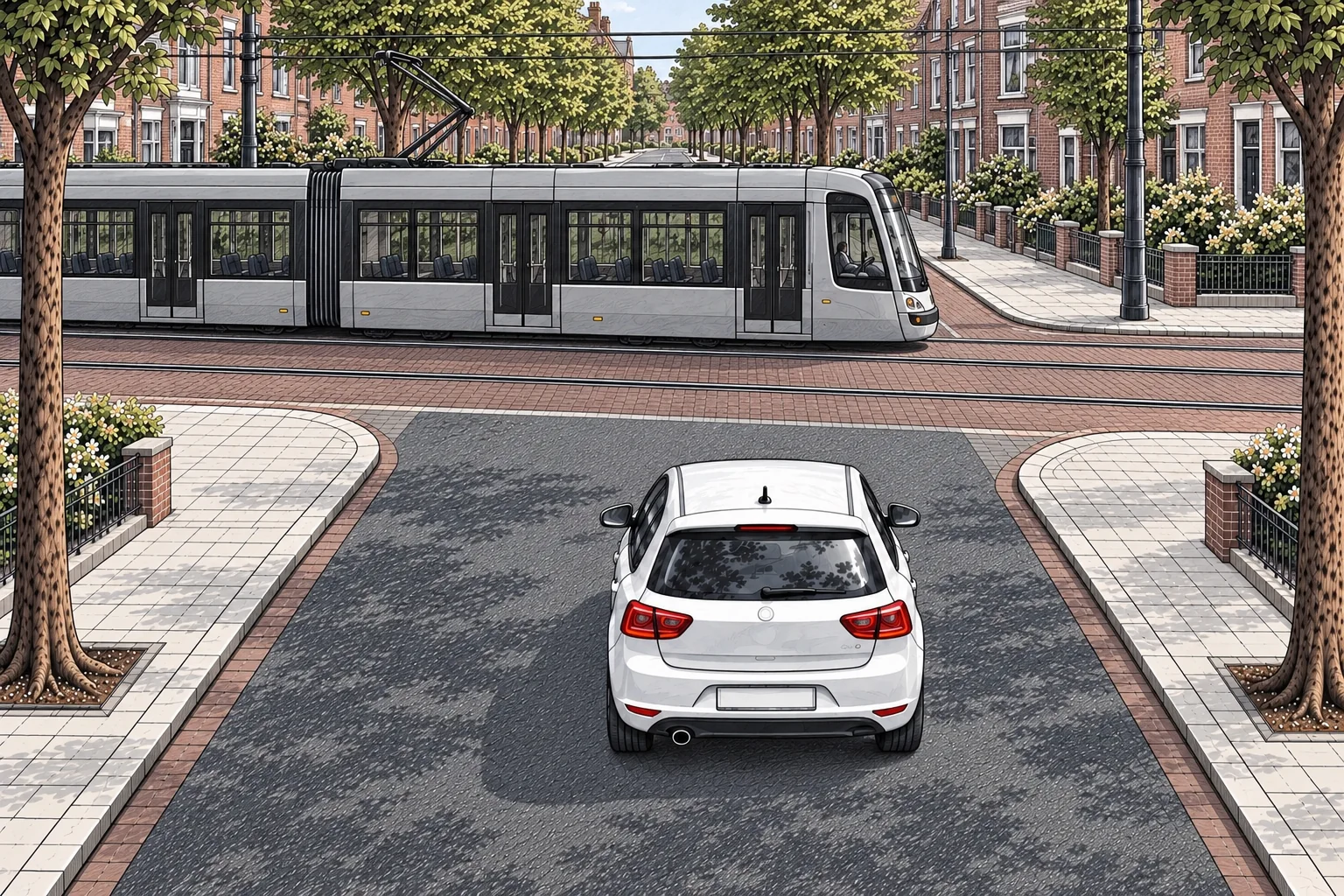
The tram is on your left. Who goes first?
Imagine an equal-priority junction without traffic lights, priority signs or markings that change the priority arrangement. You want to continue straight. A tram approaches from your left and your paths would cross.
If you apply “priority from the right” as your only rule, you have already missed something important.
The approaching vehicle is a tram. At an equal-priority junction, the general rule for tram priority matters.
Whether this really is an equal-priority junction, whether signals or signs apply, and whether the tram's path conflicts with yours.
Do not enter the tram's path. Adjust early enough to yield when required, then continue once you can do so safely.
Change one part of the scene — introduce a traffic signal, different markings or a different road layout — and you must read it again. That is precisely why remembering a single slogan is not enough.
Three lesson exercises that reveal what you understand
Use these with your qualified instructor in appropriate, supervised conditions.
As you approach suitable junctions, identify the controlling signal, sign, marking or priority rule. Do not announce “I have priority” until you can say why.
Practise checking whether there is room beyond a junction before entering it. A green signal alone does not answer that question.
During a safe, instructor-led exercise, notice what happens when a pedestrian, cyclist or other vehicle alters the situation. Ask yourself: which piece of information made me change my plan?
How to practise a complex junction without learning the route
Choose a real junction during a lesson and stop to analyse it from a safe location afterwards: which lane was legally available, who had priority, when did you identify a safe gap, and what changed during the approach? Then practise the same decision at another junction. The aim is to transfer the skill, not to rehearse the exact turn a CBR examiner might choose.
What does this tell the examiner?
CBR is not looking for a driver who recites traffic rules while turning. The examiner needs to see that you recognise the applicable situation, observe early enough, respect other road users and choose an action that is safe and timely.
DTD teaches this through observation, space and speed, decision and timing, and manoeuvre control. These are our own learning systems, not official names of CBR assessment categories.
Want to take the situation further? Read tram priority, green lights and blocked junctions, and what changes at a yellow light.
Think you know which rule applies? Try a changing road situation in the free DTD interactive test. The complete guide explains how the different decisions fit together.
Questions about the Rotterdam CBR exam
Do trams always have priority in Rotterdam?
No. At equal-priority junctions trams normally have priority, but you still have to read the applicable traffic lights, signs, markings and road layout.
Can I learn the CBR Rotterdam exam route in advance?
CBR does not publish a fixed exam route for candidates. Repeating local streets can help with familiarity, but you must be able to make decisions on any route.
Does a green light mean I must drive into the junction?
No. Check whether the way ahead is clear and your vehicle can continue without blocking the junction. The signal is one part of the decision, not the whole decision.
Sources and scope
The junction scenes are illustrative and are not published exam routes. The teaching approach follows the CBR Rijprocedure B (July 2026). Tram priority at equal-priority junctions follows Article 15 of RVV 1990. Confirm your appointment on your CBR invitation.
Editorial check: 21 October 2026. Driving Test Decoder is independent study material; it is not affiliated with, approved by or endorsed by CBR.