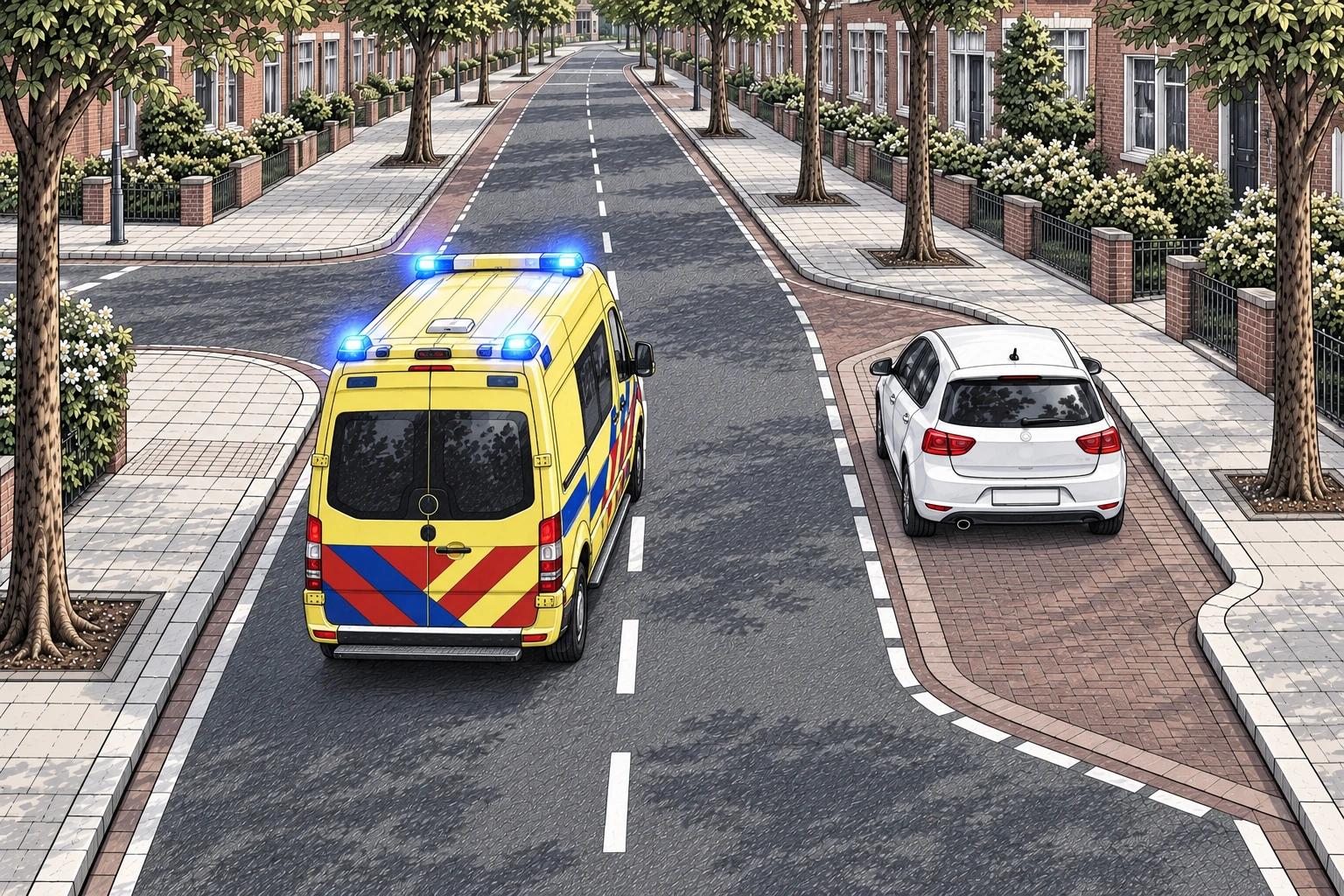
A siren behind you is not an instruction to mount the pavement. Find where the ambulance is, check the space around your car, and make room as soon as you can do so safely. In the pictured example, the paved bay offers space on the right; you still need to check its entrance and the traffic beside you.
When does the ambulance have legal priority?
Under RVV 1990, Articles 29 and 50, an emergency vehicle using the prescribed optical and audible signals is a voorrangsvoertuig (priority vehicle); road users must let it pass. Blue lights alone warn you to pay close attention, but do not by themselves establish the Article 50 priority status. The Dutch government explains the signals.
Where can you actually make space?
Check mirrors and the road ahead, then choose a place the vehicle can use. On a wide street, a clear roadside bay may work. Indicate before a lateral move if needed, check for cyclists and pedestrians, and ease into the space without an abrupt swerve. Once the ambulance passes, check traffic again before leaving the bay. The relevant observation changes with the move.
On a narrow street, a cycle track or pavement is not a free escape lane. If there is no safe opening yet, continue predictably at a lawful speed and use the next suitable space. An unnecessary full stop in the only narrow passage can make things worse. The Dutch road-safety organisation VVN advises keeping to the traffic rules while making safe room.
What if you are waiting at a red light?
The ambulance's exception to certain traffic rules is not yours. Do not drive through your red light to clear the queue. If you can move within the available space without entering the junction, blocking a crossing or endangering anyone, do so carefully. If no such space exists, stay put and let the emergency driver choose a route. If an authorised traffic officer gives directions, follow those directions.
What matters on the CBR exam?
The CBR Rijprocedure B describes observation, adjusted driving, decision making and vehicle control. In this situation the examiner can see whether you locate the emergency vehicle, leave usable space without creating a new danger and rejoin traffic safely. There is no separate published “ambulance manoeuvre” with one compulsory steering pattern.
In a lesson, ask your instructor for three contrasting situations: a clear bay, a narrow road with cyclists, and a red-light queue. State where you would make room in each and what would make you wait. The correct action changes with the space, not with the volume of the siren.
Driving Test Decoder
When the siren appears, you need a space decision
The complete DTD guide connects observation, positioning and controlled recovery so you can practise emergency-vehicle situations without inventing a universal pull-over rule.
See the full practical guide